






































📗 How Micro-Utopias Interact With Hostile States
A Survival Strategy for Non-Coercive Communities
Introduction: Hostility Is the Default
States do not need to be evil to be hostile.
They are structurally suspicious of systems that:
do not rely on money
do not rely on hierarchy
do not rely on obedience
do not fit administrative categories
Micro-utopias assume benign neglect at best, pressure at worst.
1. Micro-Utopias Do Not Confront States
They do not:
seek recognition
seek exemption
seek confrontation
seek ideological legitimacy
They remain boring, small, and legible enough to avoid attention.
Visibility is minimized without secrecy.
2. No Single Point of Suppression
States suppress movements by:
arresting leaders
freezing accounts
banning organizations
seizing assets
Micro-utopias have:
no leaders
no accounts
no central organization
no collective treasury
There is nothing to ban.
3. Legal Camouflage
Micro-utopias appear as:
housing cooperatives
eco-villages
extended households
agricultural collectives
non-profits (locally)
They use existing legal shells without ideological labels.
They are legally unremarkable.
4. Distributed Compliance
Rather than collective defiance:
individuals comply personally
villages adapt locally
federation norms remain informal
There is no coordinated illegal act to prosecute.
5. Exit Over Resistance
When pressure increases:
individuals leave quietly
villages dissolve
new villages form elsewhere
States cannot suppress what does not insist on permanence.
6. Non-Threatening Economic Footprint
Micro-utopias:
do not compete at scale
do not disrupt labor markets
do not challenge taxation directly
do not accumulate capital
They are economically irrelevant to power centers.
7. Social Legibility
They present as:
peaceful
family-friendly
environmentally positive
socially stabilizing
This reduces political incentive to intervene.
8. Federation Without Headquarters
Federations:
have no office
have no legal body
have no spokesperson
have no ideology statement
Coordination is relational, not institutional.
9. Why Hostile States Eventually Ignore Them
States optimize for:
revenue
control
legitimacy
large-scale threats
Micro-utopias offer none.
They are too small to fear and too diffuse to crush.
Conclusion
Micro-utopias survive hostile states by:
Never becoming something the state needs to defeat.
They are not rebels.
They are uninteresting.
One-Sentence Summary
Micro-utopias survive hostile states by avoiding confrontation, centralization, and visibility — making suppression costly and pointless.
📙 The Legal Architecture That Makes Micro-Utopias Hard to Dismantle
Defensive Design Without Sovereignty Claims
Introduction: Law Is a Terrain, Not a Shield
Micro-utopias do not rely on:
legal recognition
constitutional protection
political goodwill
They rely on structural redundancy across legal forms.
1. Fragmented Legal Identity
Each village uses:
its own legal wrapper
jurisdiction-specific forms
minimal inter-village contracts
There is no single legal entity to dissolve.
2. Asset Distribution
Assets are:
locally held
diversified
not pooled
not centrally owned
Land, tools, and infrastructure are structurally unseizable at scale.
3. No Central Treasury
There is:
no federation bank account
no shared capital pool
no central funding source
Financial suppression cannot propagate.
4. Contract Minimalism
Micro-utopias avoid:
long-term binding contracts
enforceable internal obligations
dependency-creating agreements
This prevents legal leverage.
5. Personal Rather Than Collective Liability
Members are:
not employees
not debt-holders
not bound to performance
Liability does not scale.
6. Forkability as Legal Defense
If a structure becomes risky:
it dissolves
members reconstitute elsewhere
no continuity claim is made
Legal pursuit loses its target.
7. Compliance Without Capture
Micro-utopias:
follow health and safety rules
pay required personal taxes
avoid legal exemptions
They comply individually, not institutionally.
8. Absence of Legal Claims
They do not:
claim autonomy
claim sovereignty
claim special status
Claims invite enforcement.
Silence avoids it.
9. Time as a Defensive Weapon
Legal systems move slowly.
Micro-utopias:
reorganize quickly
dissolve easily
reappear elsewhere
The system outruns enforcement.
10. Why Dismantling Rarely “Works”
To dismantle micro-utopias, a state would need to:
monitor thousands of households
outlaw informal cooperation
criminalize mutual aid
At that point, legitimacy collapses.
Conclusion
Micro-utopias are legally resilient because:
They never become a single legal object.
They are patterns of living, not institutions.
One-Sentence Summary
Micro-utopias are hard to dismantle because they are legally fragmented, asset-distributed, leaderless, and forkable — making enforcement expensive and ineffective.
📘 How Micro-Utopias Avoid Becoming Blacklisted or Labeled ‘Cults’
Maintaining Legitimacy Without Compromising Structure
Introduction
Communities that deviate from mainstream norms are often branded as cults.
Labels attract scrutiny, regulation, and suppression.
Micro-utopias structurally prevent this risk.
1. Transparency Without Exposure
Open events for neighbors and authorities
Publicly visible activities
Normalized governance and routines
Effect: Reduces fear of hidden agendas.
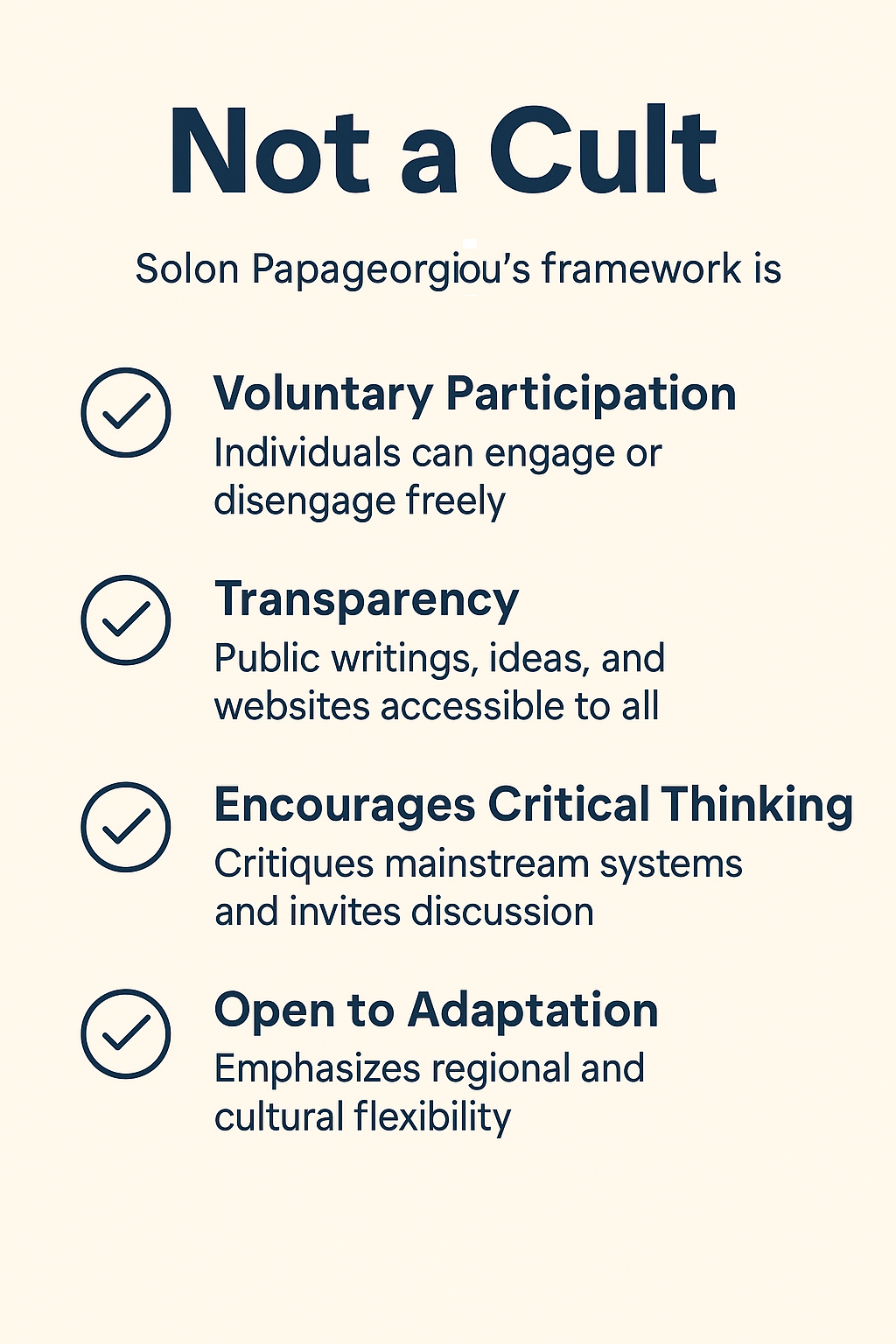
2. Avoid Ideological Dogma
Participation is voluntary
No mandatory belief systems
Decisions are practice-based, not faith-based
Effect: Cannot be legally or socially framed as a cult.
3. Scale Control
Maintain small population per village (150–300)
Rotate or split groups before reaching critical size
Effect: Limits visibility and sensationalism.
4. External Engagement
Collaborate on non-controversial projects
Participate in community services or disaster relief
Effect: Builds social legitimacy and goodwill.
5. Avoid Exclusive Membership Language
No “enrollment” rituals
No loyalty oaths
No property or work coercion
Effect: Cannot be characterized as coercive or isolating.
6. Neutral Communication
Public communications are factual
Avoid “us vs. them” rhetoric
Share achievements in neutral terms
Effect: Minimizes suspicion from media, neighbors, and regulators.
7. Exit Without Penalty
Guarantee easy departure
Respect privacy and belongings of leavers
Effect: Prevents legal claims of entrapment or manipulation.
Conclusion
By remaining small, voluntary, transparent, and neutral, micro-utopias cannot credibly be labeled cults, protecting them from social or legal targeting.
📗 Tax, Zoning, and Land-Use Survival Guide
Legal Compliance Without Losing Structural Integrity
Introduction
Even small communities must navigate:
property law
municipal zoning
taxation requirements
Micro-utopias adopt strategies to operate safely within legal frameworks.
1. Property Structure
Individual or cooperative land titles
Avoid collective corporate ownership that attracts scrutiny
Use legal entities (LLCs, trusts) for shared infrastructure
Effect: No single legal target exists.
2. Zoning Compliance
Align land use with local zoning codes
Frame activity as residential, agricultural, or educational
Avoid commercial zoning unless legally sanctioned
Effect: Prevents forced relocation or closure.
3. Tax Strategy
Residents pay personal income tax as individuals
Community-owned resources structured to minimize liability
Non-profit structures for educational or cultural programs
Effect: No collective tax liability to trigger enforcement.
4. Building and Safety Codes
Adhere to local building codes for housing
Maintain fire, health, and sanitation compliance
Inspections welcomed voluntarily
Effect: Avoids fines, forced demolition, or legal action.
5. Infrastructure Planning
Use modular, low-impact construction
Avoid centralized utilities that create regulatory targets
Leverage renewable energy and water collection
Effect: Operational independence while remaining within legal bounds.
6. Gradual Expansion
New villages established in phases
Federated structure prevents single-site overpopulation
Avoids triggering “planned community” regulations
Effect: Keeps communities below regulatory attention thresholds.
Conclusion
By designing for legal compatibility at the individual, household, and village level, micro-utopias maintain safety and operational continuity.
📙 What Happens If a State Tries Anyway?
Contingency Planning for Enforcement Scenarios
Introduction
Even with careful planning, authorities may intervene. Micro-utopias prepare structural defenses rather than rely on negotiation alone.
1. Distributed Vulnerability
Each village is autonomous
No central federation office
No single asset or bank account
Effect: State cannot target the whole system at once.
2. Legal Camouflage
Villages registered as non-controversial entities
Multiple legal wrappers used in parallel
No ideological branding
Effect: Enforcement is expensive and slow.
3. Exit and Reconstitution
Individuals relocate seamlessly
Villages can split or reform elsewhere
Knowledge and culture persist without central control
Effect: State action may displace but cannot destroy the pattern.
4. Voluntary Compliance for Non-Threatening Rules
Obey personal tax, safety, and environmental laws
Avoid illegal gatherings or prohibited infrastructure
Effect: Reduces legitimate grounds for coercive action.
5. Rapid Reorganization
Tasks, roles, and spaces are modular
Dispersed teams can resume operations quickly
No centralized decision chain slows recovery
Effect: Disruption is temporary.
6. International and Local Neutrality
Avoid political affiliation
Engage in community service
Frame activities neutrally to the press
Effect: Reduces pressure from public opinion.
Conclusion
If a state intervenes, micro-utopias survive because:
they are modular and decentralized
legal compliance shields individuals
the system can disperse and reform rapidly
The system cannot be crushed, only delayed.
Combined Summary
Micro-utopias survive scrutiny, regulation, and hostility because they:
remain small, voluntary, and neutral
comply legally at individual and village levels
decentralize power, property, and responsibilities
maintain flexible exit and reconstitution pathways
Result: They are resilient to labeling, legal action, and even hostile state intervention.